Most churches now have a website but many of them are hidden away and will only be found by the existing congregation.
If you can get a good 'ranking' on Google you'll find it can make quite a difference. There are hundreds of good online guides to 'search engine optimisation' but here's a very basic start.
If you can get a good 'ranking' on Google you'll find it can make quite a difference. There are hundreds of good online guides to 'search engine optimisation' but here's a very basic start.
1. Be consistent with your keywords
You'll gain credibility if your main keywords (e.g. "church in winchester") appears in the title of the page (the text at the very top of the browser), regularly throughout your site and also in your metadata (the hidden text that you can edit with administrator access to your site).
2. Get a link to your site on other websites

Strong links are vital
Most search engines decide which sites are important by seeing how many other sites are linking to them. For example, if you can get a link to your site on the BBC website it will make your site appear more credible and will push it up the rankings. So, when you are sending out a press release, always include your website and it might just get included.
But...be careful who you associate with. If you link to 'spam' sites or so-called 'link farms', Google will not think of you as credible.
But...be careful who you associate with. If you link to 'spam' sites or so-called 'link farms', Google will not think of you as credible.
3. Add something regularly
Google is a big fan of websites which are updated regularly with new content. If you've got the time, consider having a blog page on your site where you can add things like sermon notes or your glorious ramblings about the state of society.
4. Use a free trial of Google Ad-words
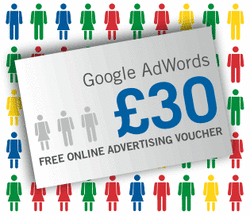
Click and search for 'adwords' to get £30 free
Internet advertising is only expensive if you want to appear at the top of Google every time someone searches for 'churches'.
However, the chances are that you want to grab the attention of people searching for something more specific, such as 'Churches in Yeovil' or 'Churches in South Somerset'.
These very specific phrases are much cheaper and a free trial will last for months with no obligation to buy more adverts. To make it last longer, you need to turn off the option to advertise on the whole Google 'Display Network'.
Free trials are available through various sites - I used TopCashBack (search for 'adwords'). Please note - this link will earn commission for the site.
However, the chances are that you want to grab the attention of people searching for something more specific, such as 'Churches in Yeovil' or 'Churches in South Somerset'.
These very specific phrases are much cheaper and a free trial will last for months with no obligation to buy more adverts. To make it last longer, you need to turn off the option to advertise on the whole Google 'Display Network'.
Free trials are available through various sites - I used TopCashBack (search for 'adwords'). Please note - this link will earn commission for the site.
5. Put yourself on the map
Getting your church on Google Maps is simple enough, as long as you have an address that Google can send a postcard to for verification. If you meet in a temporary location, like a school, you might find it trickier.
Photo from topher76
